How to unstake SOL
Unstaking SOL takes three steps: deactivate the stake in your wallet, wait, then withdraw it to your main balance. The SOL is usually free by the next epoch (Solana's reward period, about a day), sometimes later when many stakers exit at once. It stays in your own stake account the whole time.
What happens when I unstake?
If you staked SOL from your own wallet and now can't get it back, start by checking the timing. Native stake has no fixed lock-up period, and no validator holds your coins. What slows you down is the calendar.
Solana switches stake on and off only when one epoch ends and the next begins, and an epoch (Solana's reward period) lasts about a day.
Unstaking takes three steps:
- Deactivate. This is one transaction, approved in your wallet. Many wallets label the button "Unstake". Once you approve it, the stake starts cooling down.
- Wait. By the next epoch the stake is usually inactive, which means it's free to withdraw. When many stakers exit at once, part of it can take an extra epoch or more.
- Withdraw. A second transaction moves the SOL from the stake account to your main balance. Until you do this, the SOL stays in the stake account. It doesn't come back on its own.
Why can't I get my SOL back straight away?
Solana handles stake changes once per epoch. New stakes, exits and rewards are all processed at the boundary between two epochs, so a request you make mid-epoch waits for the next boundary. If you deactivate early in an epoch, you'll wait for most of it. If you deactivate near the end, you may be free within hours.
A second delay only matters during unstaking waves. The network limits how much stake can switch off in a single epoch. When lots of stakers leave at the same time, that limit spreads their exits over several epochs, and part of your stake may have to wait.
Neither delay comes from your validator or your wallet. The validator has no control over your stake account, so an offline or badly run validator can't hold you back. The same rules apply to every staker on the network.
How long does unstaking take?
Usually until the next epoch, up to about a day, sometimes longer when many stakers exit at once. Here's each step:
| Step | How long | What your wallet shows (the wording varies) |
|---|---|---|
| Deactivate | Seconds: one transaction | "Deactivating" or "cooling down" |
| Cooldown | Usually until the next epoch, up to about a day; longer when many stakers exit at once | "Deactivating", then "inactive" or "ready to withdraw" |
| Withdraw | Seconds: one transaction | The SOL is back in your main balance |
Does a large balance take longer to unstake?
Usually not. The network limits how much stake can start leaving per epoch (currently about 9% of all staked SOL, per the Solana stake program code), and that is a very large amount. Even a very large balance is a small slice of it, so it normally leaves on the same schedule as a small one.
The wait grows only when lots of people leave at once. Then every exiting stake is cut back by the same share and the rest finishes over the following epochs. More on that in Why can't I get my SOL back straight away?
The stake program sets one network-wide limit and none per wallet. Your wallet's status ("deactivating" until it says inactive) and a block explorer show where your stake stands.
How do I unstake SOL in Phantom, Solflare or with a Ledger?
Button names can change between versions. These steps follow the wallets' help centers as of September 2026.
Phantom: unstake, then withdraw once it's inactive
- Open the Phantom browser extension and select the account you staked from.
- Open Solana from your token list and look under Native Stakes.
- Pick the stake account you want to unstake. If you've staked more than once, each stake account is listed separately.
- Click Unstake, check the details and approve.
- Come back after the epoch changes. When the stake shows as Inactive, open it, click Withdraw Stake and approve. The SOL returns to your main balance.
Solflare: regular unstake, or instant for a fee

- Open Solflare and select the wallet you staked from.
- Open the Staking tab and pick the stake account.
- Choose Unstake, check the details and approve. The regular route is free. Solflare also offers Instant Unstake, which returns SOL right away for a fee (0.5–3% depending on liquidity, per its help center).
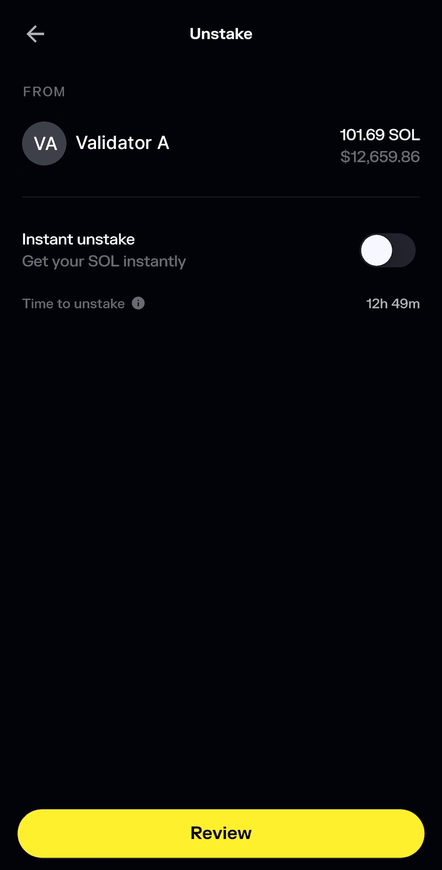
Solflare app; the amounts are an example. - After the epoch changes, open the same stake account, choose Withdraw and approve.
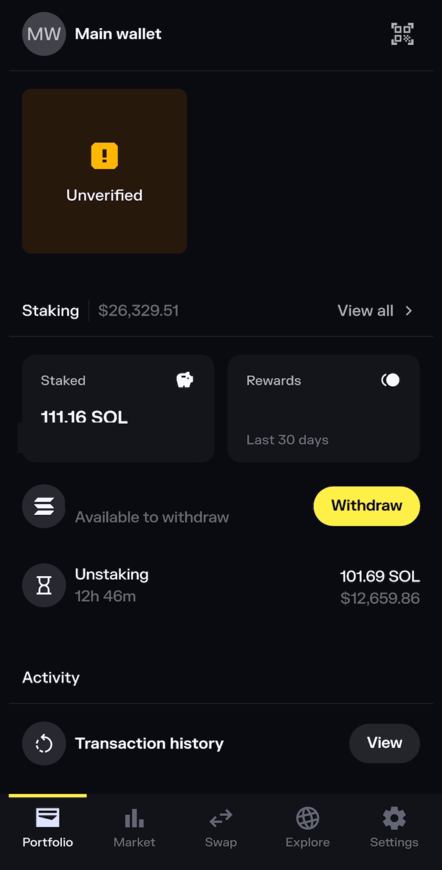
Solflare app; the amounts are an example. The APY line in the Staked card, the reward figure in the Rewards card, and the withdrawable amount below them are blacked out on purpose, not a UI bug. The "Unverified" box above is an unrelated wallet warning, not part of staking.


Ledger: the same steps, approved on the device
With a Ledger, unstaking works exactly as it does in the wallet you connected it to, Phantom or Solflare. The only difference is that the device has to approve both transactions, deactivate and withdraw. Keep the Ledger nearby, because the second step usually comes a day or two after the first.
Why does my unstaked SOL look stuck?
Check these in order:
- It's still cooling down. The status still says "deactivating". Either the epoch hasn't ended yet or the network is spreading out a big wave of exits. Check again after the next epoch change.
- It's inactive but not withdrawn. The SOL is waiting in the stake account. Open the stake account and choose Withdraw.
- There's no SOL to pay the fee. Withdrawing is a transaction, and the fee comes out of your main balance. If that balance is empty, add a little SOL first.
- You're looking at a different account. A stake account belongs to the wallet address that created it. If your wallet holds several accounts, or you've restored it on a new phone, switch to the address you staked from.
- It wasn't native staking. Exchange staking follows the exchange's own rules and timelines. You exit liquid staking tokens by swapping or redeeming them, not with these steps.
If none of these fits, look up your wallet address in a Solana block explorer. It shows the stake accounts linked to that address and their status, whatever your wallet's screen says.
Is there a faster way out?
Not with native staking. The epoch wait is part of how it works. If you need faster access, liquid staking works differently. Instead of a stake account, you hold a token that stands for your staked SOL, and you can usually swap it back to SOL right away rather than waiting for the epoch to end.
The speed has costs:
- Swapping can mean trading or protocol fees.
- Your SOL sits behind a smart contract, which adds a layer that native staking doesn't have.
- You give up choosing your validator, because the protocol spreads your stake across validators for you.
If quick access matters more to you than those trade-offs, liquid staking is a fair choice. Native or liquid staking? compares the two side by side.
Do I lose anything by unstaking?
There's no penalty. You pay two small network fees, one to deactivate and one to withdraw, and the SOL stops earning once the stake is inactive.
If you're unstaking because your validator went offline or raised its fees, you may not need to cash out at all. You can move the stake to another validator instead. What happens when your validator goes offline walks through how.
Once it's withdrawn, you can compare validators by fees and uptime before you stake again.
Want to see what a stake could earn? Try the rewards calculator; it gives an estimate, and the rate varies.
Questions
Usually until the next epoch begins. Epochs last about a day, so if you deactivate late in one, the wait can be a matter of hours. When many stakers exit at the same time, part of your stake can wait an extra epoch or more. Withdrawing afterwards is one quick transaction.
Usually just as fast as a small one: deactivate, then withdraw once the stake is inactive, usually by the next epoch (about a day). A large balance on its own doesn't slow you down; the wait only grows when many stakers exit together.
Only the network fees for two transactions, deactivate and withdraw, and both are tiny. There's no penalty for leaving a validator. What you give up is future rewards: once the stake is inactive, it stops earning. Keep a little SOL in your main balance so you can pay the withdrawal fee.
You have to deactivate first, because active native stake can't jump straight from one validator to another. Once the stake is inactive, you can delegate the same stake account to the new validator, or withdraw and stake again. Wallet support for re-delegating varies. Expect a gap without rewards, usually about an epoch.
It means you've asked to unstake and the stake is cooling down. That usually ends at the next epoch change, up to about a day, and sometimes takes longer when many stakers exit at once. Then the status changes to "inactive" or something similar, and you can withdraw. The SOL stays in your stake account the whole time.